
|
Beautiful Countryside |
|
| A new farmer’s transformation in Linhai, Zhejiang: a "sweet venture" empowering rural revitalization | ||
source:This station Release time: 2025-10-14 browse:279order
|
||
|
(China News Service, Taizhou, October 13 — Fu Feiyang, Guo Tianyu) "Do you still have sweet persimmons available, and what’s the current price?" "I’d like to grow them too—how difficult is the cultivation technique?" In recent days, the phone of Huang Haijian, a new-generation farmer in Furong Village, Taozhu Town, Linhai City, Zhejiang Province, is constantly busy—on one end are booming orders, and on the other, inquiries from fellow farmers.
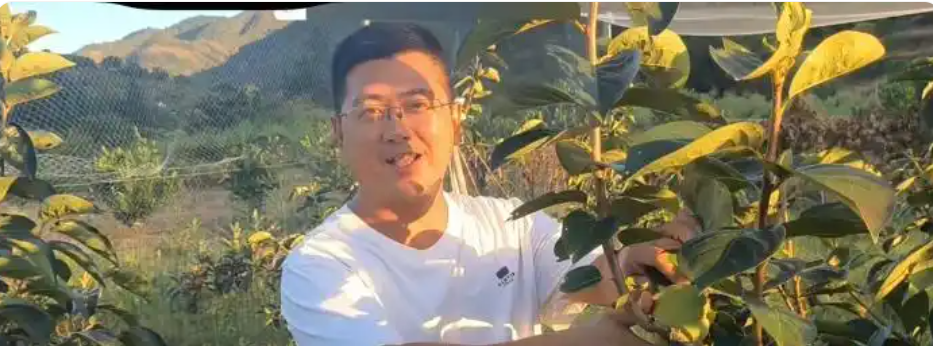
In the village's contiguous Taiqiu sweet persimmon plantation, the heavy fruits bend the branches low. Huang Haijian weaves through the trees, carefully checking the ripeness of the fruit. Once a skilled technician in air conditioning manufacturing, he has now successfully transformed into a locally renowned expert in Taiqiu sweet persimmon cultivation.
Huang Haijian inspects the growth of persimmons at the planting base. Photo by Guo Tianyu.
Huang Haijian used to work in the air conditioning manufacturing industry, with over ten years of experience. After being elected as a village official in Furong Village in 2020, he gained deeper insight into and began rethinking the development of agriculture in his hometown.
"My father grew tangerines for decades, but the income was meager—sometimes it didn't even cover the cost of pesticides and labor," Huang recalled. "Even during festivals, when we wanted to give fruit as gifts, we had to buy high-quality ones from elsewhere." This stark contrast made him realize that traditional agriculture would gradually be phased out by the market if it didn't undergo transformation and upgrading.
In 2022, a chance encounter led Huang Haijian to discover the Taiqiu sweet persimmon in Quzhou. This variety features a unique taste, combining the crispness of an apple, the juiciness of a pear, and the sweetness of a honeydew melon. It also has a long tree lifespan and relatively low management costs. Compared to local fruits such as waxberries and peaches, Taiqiu sweet persimmons face less market competition and offer higher added value.
Huang Haijian then leased 70 acres of land to trial the crop, becoming the first person in the area to grow Taiqiu sweet persimmons.Growing sweet persimmons, however, is no easy task—selecting and cultivating the right rootstock is a major challenge. Huang discovered that a specific wild variety must be used as specialized rootstock. After multiple trials, he successfully overcame the difficulties in grafting and gradually developed a set of standardized cultivation techniques.
In September this year, Huang Haijian's first batch of Taiqiu sweet persimmons hit the market, receiving strong positive feedback. "We're getting a purchase price of 30 yuan per pound. Gift boxes with eight persimmons sell for 168 yuan, and supply still can't meet demand—some customers have placed orders for over 300 boxes at once," Huang said with a smile.
The booming sales have completely dispelled local villagers' initial doubts. Those who once worried, "Who would buy persimmons at such a high price?" have now changed their minds and are proactively coming to learn the cultivation techniques. To date, farmers in surrounding areas have jointly planted more than 300 acres of Taiqiu sweet persimmons. Huang Haijian is also providing seedlings to local farmers at 35 to 40 yuan per plant—below market price—and offering free technical guidance.
"New-generation farmers should also have a sense of entrepreneurial responsibility," said Huang Haijian. His goal is not just to grow high-quality persimmons himself, but to drive development across the entire region. He is now promoting the creation of a regional public brand called "Furong Blossoms," under which qualified Taiqiu sweet persimmons will be uniformly packaged and sold to increase product value.
As the planting area expands, Huang plans to build a standardized nursery base to further reduce cultivation costs for local farmers. At the same time, he hopes to revitalize local land resources through the Taiqiu sweet persimmon industry and attract more young people to return home and start businesses. "Agriculture needs branding and standardization to achieve sustainable growth," Huang said. Moving forward, he plans to collaborate with fellow farmers to build a strong brand, unifying cultivation techniques, quality standards, and sales channels, so that this "sweet venture" can truly contribute to rural revitalization.
|
| About Us | Contact Us | Cooperate | Advertisement |
|
Address: Digital National History Image Base, 33 Gongchen North Street, Fangshan District, Beijing Hotline: 010-53678506 Email: cccntv2024@163.com |
|
|


|
Copyright Contemporary Wuzhou Culture Communication (Beijing) Co., Ltd © two thousand and twenty-four
|