


China org.cn: Currently, the world is facing multiple crises and challenges, and a return of Trump to the White House would introduce additional uncertainties to global governance and international cooperation. What changes would occur in the world order during a Trump 2.0 era? What role should China play? How should the world view Trump's tariff plans? To address these questions, during the 9th Annual China Global Think Tank Innovation Forum, which is hosted by the Center for China and Globalization (CCG) and the Chinese People's Association for Friendship with Foreign Countries, and supported by the Academy of Contemporary China and World Studies, we specially interviewed Amitav Acharya, Distinguished Professor at American University and UNESCO advisor, renowned for his studies in international relations. The following is the transcript of the interview:
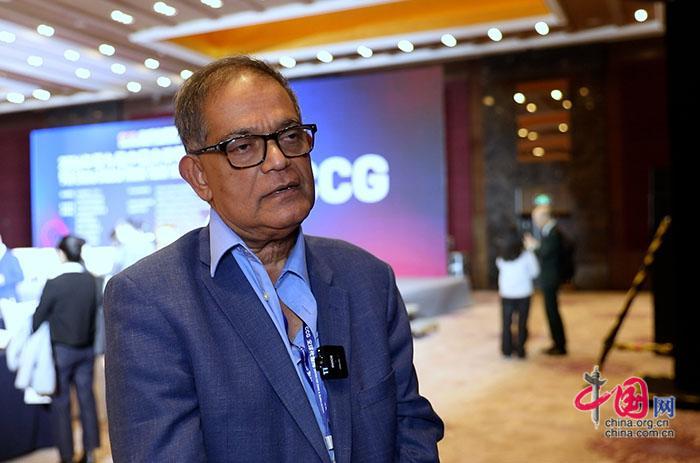
China org.cn: What challenges would global governance and international cooperation face during a Trump 2.0 era? What are your concerns and worries regarding this?
Amitav Acharya: My primary concern with a Trump 2.0 era is that Trump could inadvertently trigger a war, not necessarily by intention, but through miscalculations and impulsive policy decisions leading to conflict. Trump might undermine trust and confidence, not only with countries like China where mutual trust is already limited, but also between the United States and its allies. Relationships such as those between the U.S. and European nations, or the U.S. and Canada, could be affected. Moreover, Trump may resort to unilateral actions, imposing threatening sanctions on all countries, poisoning the global atmosphere, intensifying global competition, and making the world a darker place. Trump's actions would not only bring about psychological changes; more likely, he could unintentionally spark a war because he believes he can control everything.
China org.cn: During his campaign, Trump threatened to impose tariffs on all imported goods, especially increasing tariffs on Chinese goods to 60%, and he even went as far as to threaten a 100% tariff on imports from BRICS countries. How likely is it that Trump's tariff plans would be implemented? How should China respond?
Amitav Acharya: As you mentioned, Trump's targets are not only China but also America's allies and the BRICS countries. Trump is leveraging the strength of the U.S. dollar and the American market, wielding America's economic influence to impose sanctions. In the short term, he might implement some of these sanctions, but this could also be part of a negotiation strategy. During his previous term, the U.S. withdrew from the North American Free Trade Agreement (NAFTA), yet ultimately reached a new agreement that bore similarities to the original but was in certain respects more favorable to the U.S. Thus, Trump may be using these threats as bargaining chips, applying pressure to gain concessions before formally engaging in negotiations. Therefore, one should not take every word he says at face value.
If Trump were to indeed implement these tariff policies, it would ultimately be detrimental to the United States. All the targeted countries would seek alternative routes, both during his term and in the longer-term future. These nations would strive to reduce their reliance on the U.S. dollar so that they are less vulnerable when faced with American sanctions. Countries like China would expand their markets beyond the United States. For instance, India, much like China, has a vast market of 1.4 billion people. If the two countries were to cooperate, they could essentially open up an entire market between them. Therefore, Trump's approach could backfire in the long run, proving counterproductive and disadvantageous for the United States. The affected countries would diversify their trade relationships and economic dependencies, diminishing the leverage the U.S. currently holds through its economic power and the dominance of the dollar. This shift could lead to a more multipolar economic world order where the influence of the U.S. is relatively diminished.
China org.cn: Looking back now at your book "The End of American World Order" from 10 years ago, how do you feel?
Amitav Acharya: The second edition of "The End of American World Order" was published following the end of Trump's first presidential term, and some of its content remains highly relevant today. In the book, I discussed the era of Trump 1.0, noting that Trump represented an anomaly characterized by self-isolation, economic nationalism, transactionalism, and unilateralism. I also pointed out that Trump was not a fan of global cooperation or international institutions. All these issues are likely to resurface.
China org.cn: So, how will the world order evolve during a Trump 2.0 era?
Amitav Acharya: The world order will undergo changes, transitioning into a post-American era. However, the point I want to convey is that many of these changes, including Trump's election, are the outcomes of the decline of a Western-dominated world order, not the causes. Over the past 50 years, numerous shifts have already taken place – such as the rise of China and India, the fragmentation of the U.S.-led multilateral system, and changes in ideology. Human rights and democracy are no longer the sole guiding ideologies for all countries; today, multiple ideologies coexist. These transformations have been occurring over the past 50 to 60 years.
To some extent, Trump has accelerated the dissolution of the old world order, but he is not the cause of its decline. In fact, he himself is a reflection of these ongoing changes. Voters supported Trump because they were dissatisfied with the status quo, and Trump capitalized on this sentiment. Therefore, my argument still holds: the world order is in transition, and this change is irreversible; even Trump cannot alter this trajectory. Now, this transformation might be expedited, but it will only go so far. I am about to publish a new book titled "The Past and Future of World Order," in which the central thesis is that the world order is not dominated by any single country or civilization. Many of the ideas underpinning the world order come from a variety of civilizations. Contributions have been made by the Sumerians, Egyptians, Chinese, Indians, Muslims, Incas, Mayans, Europeans, Americans, as well as the Greeks and Romans. Thus, the end of American or Western dominance does not spell the end of the world order. I believe that the conclusion of Western hegemony is actually beneficial for the world.
China org.cn: In the face of changing world order, what advice do you have for China?
Amitav Acharya: China should accelerate this change and take on more responsibility to mitigate the potential damage that Trump might bring, such as playing a more constructive role in global governance. I am not suggesting that China should monopolize these efforts; the world order does not need to shift from one dominated by the West to one solely led by China. Instead, China should work towards establishing a diversified and multipolar world order. China has the full capability to achieve this.

